
JavaScript is one of the most popular programming languages in the world, powering everything from simple websites to complex web applications. At TechYantram, we use JavaScript extensively to build scalable and high-performance solutions.
Understanding data types in JavaScript is fundamental for writing efficient and bug-free code. In this guide, we’ll break down all JavaScript data types with examples and real-world use cases.
What Are Data Types in JavaScript?
Data types define the type of data a variable can hold. JavaScript is a dynamically typed language, which means you don’t need to explicitly define the type of a variable.
Example:
let name = "TechYantram"; // string
let count = 10; // number
Types of Data in JavaScript
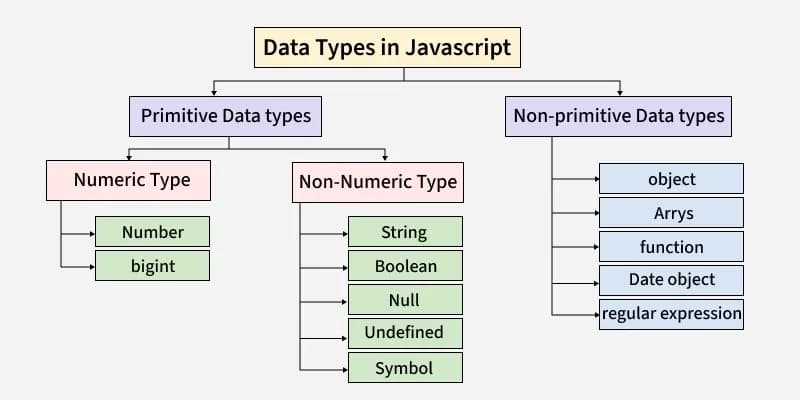
JavaScript has two main categories of data types:
1. Primitive Data Types
2. Non-Primitive (Reference) Data Types
Primitive Data Types
Primitive data types are immutable and stored directly in memory.
1. Number
Represents both integers and floating-point numbers.
let age = 25;
let price = 99.99;
2. String
Used to represent text.
let company = "TechYantram";
3. Boolean
Represents true or false values.
let isActive = true;
4. Undefined
A variable declared but not assigned a value.
let x;
console.log(x); // undefined
5. Null
Represents an intentional absence of value.
let data = null;
6. BigInt
Used for very large integers.
let bigNumber = 123456789012345678901234567890n;
7. Symbol
Used for unique identifiers.
let id = Symbol("id");
Non-Primitive Data Types
These are reference types and can store collections of data.
1. Object
Used to store key-value pairs.
let user = {
  name: "Goutam",
  role: "Developer"
};
2. Array
A special type of object used for ordered collections.
let technologies = ["Node.js", "React", "MySQL"];
3. Function
Functions are also treated as objects in JavaScript.
function greet() {
  return "Hello from TechYantram!";
}
Real-World Usage in TechYantram Projects
At TechYantram, understanding data types helps us:
- Optimize backend APIs using Node.js
- Manage large datasets efficiently
- Prevent bugs in complex applications
- Build scalable systems
For example, we use:
- Objects for API responses
- Arrays for data lists
- Booleans for feature flags
- BigInt for financial calculations
Common Mistakes Developers Make
- Confusing
nullandundefined - Treating arrays as primitive types
- Ignoring type coercion
- Not validating data types in APIs
Why Data Types Matter
Proper use of data types:
- Improves performance
- Enhances code readability
- Reduces bugs
- Makes debugging easier
Conclusion
JavaScript data types are the foundation of programming. Whether you're building a simple website or a complex application, mastering data types is essential.
At TechYantram, we emphasize strong fundamentals to build scalable and efficient software solutions.
Want to Build Scalable Applications?
TechYantram specializes in modern web development using Node.js, React, and advanced backend architectures.
👉 Visit: https://techyantram.com